Most homes with one bathroom are best served by a combi boiler, while properties with two or more bathrooms usually need a system boiler and a cylinder. Sizing should be worked out from radiator output and hot water demand, not from the size of the old boiler. A replacement typically costs £2,000 to £4,500 supplied and fitted, takes one to two days, and must be carried out by a Gas Safe registered engineer.
Almost nobody replaces a boiler because they want to. It happens because the old one has failed in February, or because a survey has flagged it, or because the bills have crept up year after year. That usually means the decision gets made in a hurry, which is exactly when people pay too much for the wrong thing. This guide is the conversation we have with customers across Essex and London before we quote, written down.
When It Is Time to Replace
A boiler that is working, efficient and cheap to run is not a boiler that needs replacing. These are the signs that actually matter.
- Age past 12 to 15 years: Efficiency falls away and parts get harder to source. A boiler from 2010 will be noticeably more expensive to run than a modern condensing unit doing the same job.
- Repeat repairs: Once you are paying for a repair more than once a year, the money is better spent on a replacement. We will tell you when that line has been crossed.
- Bills climbing with no change in use: If nothing about the household has changed and the gas bill keeps going up, the boiler is working harder for the same heat.
- Pressure that will not hold: Topping up the system every few weeks points at a leak, a failed expansion vessel or a tired heat exchanger.
- Banging, kettling or rumbling: Often sludge in the system rather than the boiler itself, which is a powerflush rather than a replacement. Worth diagnosing before you spend.
- A yellow flame instead of a blue one: Stop using it and call a Gas Safe engineer the same day. That is a combustion problem, not a maintenance one.
Combi, System or Regular
There are three types and the right one is decided by your hot water demand, not by fashion.
- Combi: Heats the house and makes hot water on demand with no cylinder and no loft tank. Right for the majority of one-bathroom homes and flats, and it frees up a cupboard. The limit is flow rate: run two showers at once and both will suffer.
- System: Works with a hot water cylinder but no loft tank. This is the answer for two or more bathrooms, or a household where several people want hot water at the same time. You lose the airing cupboard space and gain a much better shower.
- Regular, also called conventional or heat-only: Cylinder plus a cold-water tank in the loft. Usually kept rather than chosen, in older properties where the pipework and the mains pressure make a conversion expensive.
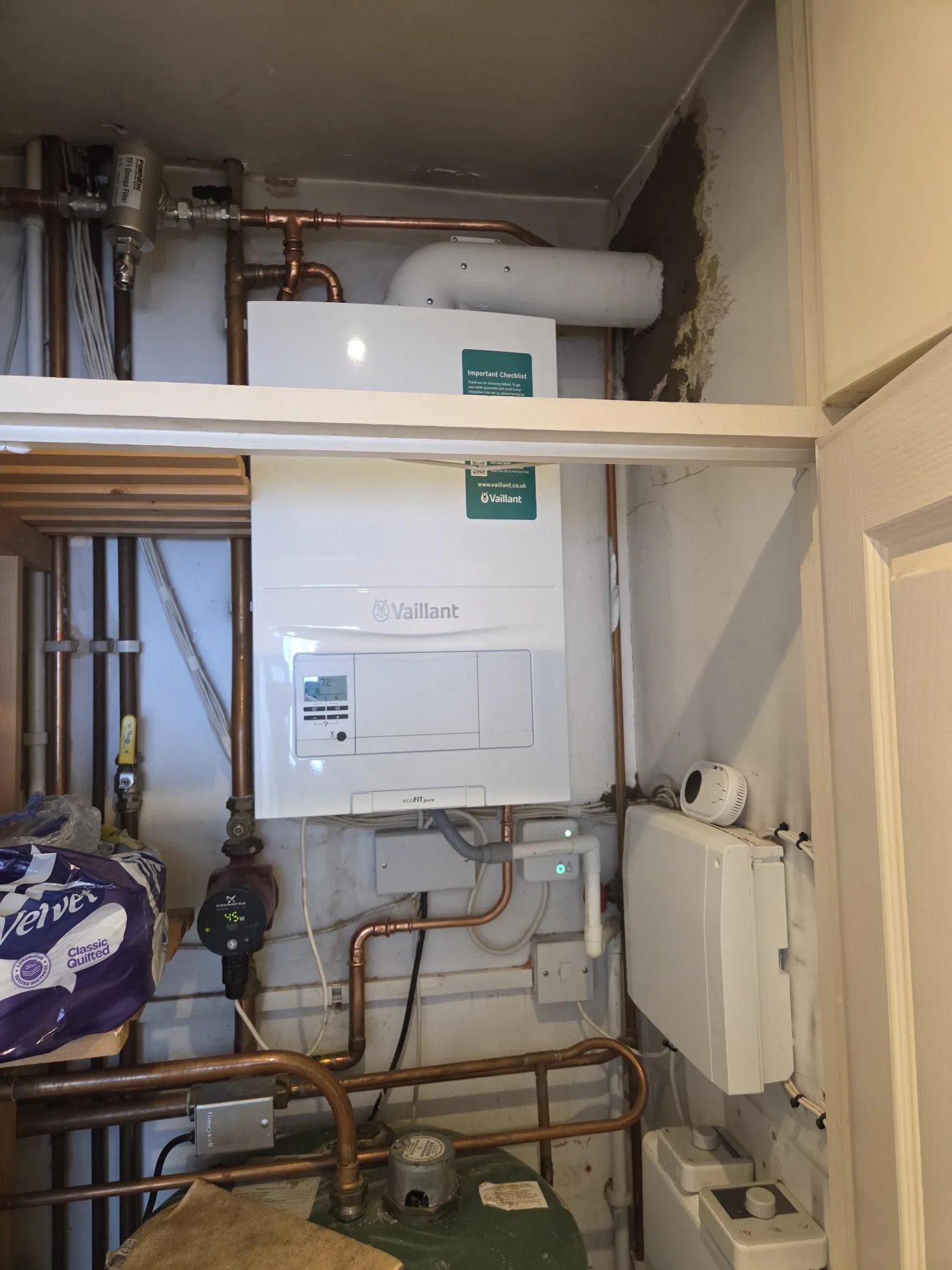
We fit the Vaillant range as standard. They are reliable, the parts are easy to get hold of quickly, and the warranties are strong. If you would rather we priced a different make, say so and we will give you an honest comparison rather than a sales pitch.
Thinking about a new boiler?
Call Green Plumbing and Heating on 07535 674043. Free quotes and a proper survey across Essex, London and Kent.
Call for a Free QuoteGetting the Size Right
The single most common mistake is sizing the new boiler from the old one. The old one may well have been wrong too. Size is worked out from the heat the property actually loses and the hot water the household actually uses.
- Heat demand: Add up the radiator outputs. That tells you what the boiler needs to deliver to the heating circuit, and it is usually a lot less than people expect.
- Hot water demand: For a combi this is about flow rate in litres per minute at your incoming mains pressure. A 24 kW combi on a weak mains supply will still give you a poor shower.
- Oversizing costs you money: A boiler that is too big short-cycles, firing and stopping repeatedly. That wears components out and wastes gas.
- Check the mains first: We measure incoming flow and pressure at the survey. If the mains cannot support a combi, we will say so before you have bought one.
Controls Are Worth the Money
A good boiler on poor controls is a waste. Controls are the cheapest efficiency you can buy, and they are the part of the system you actually interact with.
- Smart control: We fit Hive as standard. Heating and hot water from your phone, a proper schedule, and the ability to turn it off when plans change.
- Thermostatic radiator valves: Room-by-room control. If you are heating a spare bedroom to the same temperature as the lounge, you are paying for nothing.
- Weather compensation or load compensation: Lets the boiler run at a lower flow temperature when it can, which is where a condensing boiler actually condenses and earns its efficiency rating.
- A magnetic filter: Not a control, but fit one. It catches the iron oxide before it reaches the heat exchanger and it is often a warranty condition.
What It Should Cost
Our installations across Essex and London run between £2,000 and £4,500 supplied and fitted. Where yours lands depends on the work, not on the postcode.
- Straight combi swap in the same position: Lower end of the range. One to two days on site.
- Moving the boiler: Adds pipework, a new flue route and making good. Expect three to five days.
- Conventional to combi conversion: Cylinder and tank removed, pipework reworked, mains upgraded if needed. Upper end of the range.
- System boiler with a new cylinder: The cylinder itself is a meaningful part of the cost, and it is worth buying a good one.
- A powerflush beforehand: £300 to £800. Often required to keep the new warranty valid, and always a good idea on an older system.
Whoever you use, make sure the quote is itemised and says what is included. Ours lists the boiler, the controls, the work and the certification, so the price you are given is the price you pay.
Frequently Asked Questions
For a straight swap, one to two days. For a conversion or a relocation, three to five days. We will tell you which yours is at the survey so you can plan around it, and we do not leave a system drained overnight without warning you first.
Not always, but often. A new boiler has a much finer heat exchanger than an old one, so existing sludge will block it quickly, and most manufacturers make cleaning the system a warranty condition. On a newer, clean system a chemical flush may be enough. We will tell you which yours needs rather than selling you the bigger job by default.
We do. We register the manufacturer warranty on your behalf and hand over the commissioning record and the paperwork on the day. The one thing you have to do is keep the boiler serviced every 12 months, because a missed service is the usual reason a warranty claim gets refused. We set a reminder for you.
Usually yes. The constraints are where the flue can safely terminate, where the gas supply and the condensate drain can run, and how far the new position is from the existing pipework. A garage, a utility or a loft are all common. We check all of it at the survey and price the extra work up front rather than adding it later.