A modern wall-mounted inverter air conditioning system costs £1,800 to £3,000 supplied and fitted for a single room, and takes about a day to install. It is a heat pump, so it heats as well as cools and does both efficiently. Refrigerant work must be carried out by an F-Gas qualified engineer. Conservatories, loft conversions and home offices see the biggest benefit.
Most people who ring us about air conditioning are thinking about three or four uncomfortable weeks in July. What they end up with is something they use most of the year, because the unit that cools the room in summer is the same unit that heats it cheaply in November. That is the part of modern air conditioning that still surprises people, and it is the reason the payback is better than it looks.
How an Inverter System Works
A split system has two halves. An indoor head on the wall and an outdoor condenser, joined by insulated copper pipework carrying refrigerant. Nothing is burned and no air is exchanged with outside. The system simply moves heat from one side to the other.
- The indoor unit passes room air over a cold coil, which drops the temperature and pulls moisture out of the air at the same time. The water runs away down a condensate pipe.
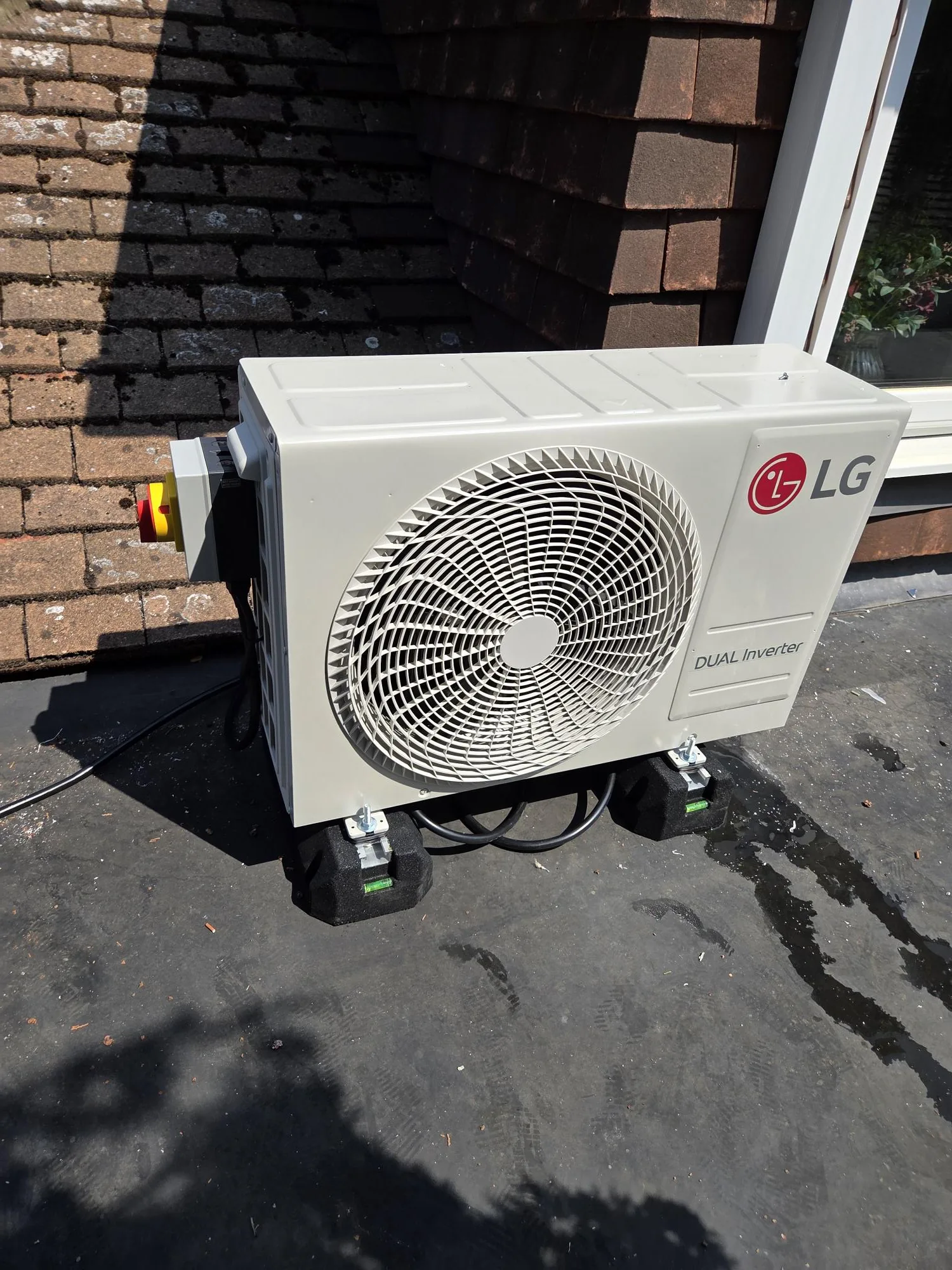
- The outdoor unit dumps that heat outside. It is the noisy half, which is why siting it sensibly matters more than most people expect.
- Inverter means variable speed. Older air conditioning ran flat out then switched off. An inverter compressor throttles up and down to hold the temperature, which uses far less electricity and is much quieter.
- Single or multi-split. One outdoor unit can serve one indoor head or several. A multi-split saves outside wall space if you want three rooms done.
It Heats as Well as Cools
Reverse the cycle and the same machine takes heat from the outside air and puts it into the room. That is a heat pump, and it is genuinely efficient: for every unit of electricity it uses, it will typically deliver three or four units of heat.
In practice that means a room with air conditioning can be warmed in minutes without firing the boiler and heating the whole house. For a home office at eight in the morning, or a conservatory in October, that is a real saving rather than a theoretical one. It also means the unit earns its keep for most of the year rather than just the summer.
Thinking about air conditioning?
Call Green Plumbing and Heating on 07535 674043. F-Gas qualified installs across Essex, London and Kent, with free quotes.
Call for a Free QuoteWhere It Makes the Biggest Difference
Air conditioning is not really about cooling the whole house. It is about fixing the two or three rooms that the central heating and the windows were never going to solve.
- Loft conversions: Heat rises and a converted loft collects it. These rooms are consistently the hottest in the house in summer and often the draughtiest in winter, which makes them the best candidates.
- Conservatories and garden rooms: Too hot to sit in from June to September and too cold from November. A single unit turns a seasonal room into a year-round one.
- Home offices: A room occupied all day by one person and a couple of screens. Heating the whole house for it makes no sense, and a small unit costs pennies to run.
- Bedrooms: Mostly about sleeping through a heatwave. Worth paying attention to the indoor unit's noise rating, and worth siting the head so it is not blowing straight at the bed.
Choosing a Brand
There is a genuine hierarchy here and it maps closely to budget.
- Daikin and Mitsubishi sit at the top. Better build quality, quieter indoor units, better performance when it is cold outside, and longer service life.
- LG, Fujitsu and Samsung cover the mid range and represent good value. Perfectly reliable units and the efficiency figures are close to the premium brands.
- Budget imports are cheaper up front and we generally advise against them. Parts availability is the problem, not the first summer of running.
More important than the badge is getting the size right. An undersized unit runs flat out and never quite gets there. An oversized one short-cycles, which is noisy and wears the compressor. We measure the room, work out the load and pick from there.
Cost and Installation Day
A typical single-room wall-mounted system runs between £1,800 and £3,000 supplied and fitted. The variables are the unit itself, the room size and how far the pipework has to travel between the indoor head and the outdoor condenser.
- Survey first: We look at the room, the wall you want the head on, where the condenser can go and how the pipework and condensate will run. The quote comes after that, not before.
- Installation day: Most single-room installs are one day. Core drilling through the wall, mounting the head and the condenser, running and insulating the pipework, and the electrical supply.
- Pressure test and vacuum: Before any refrigerant goes in, the pipework is pressure tested and evacuated. Skipping this is the usual reason a cheap install fails in year two.
- Commissioning and handover: We run the system, check the operating pressures, and show you how to use it so you are not cooling an empty house on a timer.
- Annual service: Filters, refrigerant charge, condensate drain and the outdoor coil. It keeps running costs down and the warranty intact, and we keep the reminder for you.
Frequently Asked Questions
For most houses the outdoor unit falls under permitted development, provided it is sited sensibly, is not on the principal elevation facing a highway, and the property is not listed or in a conservation area. Flats and some conversions are treated differently. We will flag it at the survey if we think you need to check with your council first.
A modern indoor head on low fan speed is quieter than a fridge, which is why they work in bedrooms. The outdoor condenser is the one to think about. We mount it on anti-vibration feet and site it away from bedroom windows and boundary walls where we can, because reflected noise off a fence is what usually causes a complaint.
Far less than people assume. A correctly sized unit holding a room at a comfortable temperature draws a few hundred watts once it has pulled the temperature down, because the inverter throttles back. Used for heating it is more efficient than an electric heater by a factor of three or four. The expensive way to run one is to leave doors and windows open.
Refrigerant is a regulated fluorinated gas, and handling it legally requires an F-Gas qualification and, for a company, registration with a body such as REFCOM. Beyond the law, it is also the practical difference between a system that is pressure tested and evacuated properly and one that loses its charge. We hold both, and you are welcome to ask to see them.